🧪 Daily Wick Testing Setup & Example
📦 What We Installed
npm install -D vitest @testing-library/react @testing-library/jest-dom @testing-library/user-event jsdom @vitejs/plugin-react
Why each package:
- vitest - Fast test runner (Jest-compatible but faster)
- @testing-library/react - React component testing utilities
- @testing-library/jest-dom - Custom DOM matchers (
.toBeVisible(),.toHaveText()) - @testing-library/user-event - Simulate user interactions (click, type)
- jsdom - Browser environment simulation for Node.js
- @vitejs/plugin-react - React support for Vitest
⚙️ Configuration Setup
vitest.config.ts:
import { resolve } from 'node:path'
import { defineConfig } from 'vitest/config'
import react from '@vitejs/plugin-react'

export default defineConfig({
  plugins: [react()],                    // React support
  test: {
    globals: true,                       // Use describe/it without imports
    environment: 'jsdom',                // Browser simulation
    setupFiles: ['./test/setup.ts'],     // Global test setup
    css: true,                           // CSS support
  },
  resolve: {
    alias: { '@': resolve(__dirname, './') }, // Path aliases
  },
})
test/setup.ts - Global Mocks:
import '@testing-library/jest-dom/vitest'
import { vi } from 'vitest'

// Mock Next.js router so tests don't break
vi.mock('next/navigation', () => ({
  useRouter: () => ({ push: vi.fn(), replace: vi.fn() }),
  useSearchParams: () => new URLSearchParams(),
  usePathname: () => '/',
}))

// Mock Supabase to avoid real database calls
vi.mock('@/lib/supabase', () => ({
  supabase: {
    auth: { getSession: vi.fn(), getUser: vi.fn() },
    from: vi.fn(() => ({
      select: vi.fn().mockReturnThis(),
      eq: vi.fn().mockResolvedValue({ data: [], error: null }),
    })),
  },
}))
🎯 Real Test Example: Trade Calculations
Here's one of our actual tests with detailed breakdown:
// test/lib/tradeCalculations.test.ts
import { describe, it, expect } from 'vitest'
import { calculatePnL, formatPnL, calculatePnLPercent } from '@/lib/tradeCalculations'
import type { Trade } from '@/types'

describe('Trade Calculations', () => {
  describe('calculatePnL', () => {
    it('should calculate profit for long trades', () => {
      // Arrange: Create test trade data
      const trade: Partial<Trade> = {
        trade_direction: 'Long',
        entry_price: 100,
        exit_price: 110,
        position_size: 10
      }

      // Act: Call the function we're testing
      const result = calculatePnL(trade as Trade)

      // Assert: Check the result is what we expect
      expect(result).toBe(100) // (110 - 100) * 10 = 100
    })

    it('should calculate loss for long trades', () => {
      // Arrange: Loss scenario
      const trade: Partial<Trade> = {
        trade_direction: 'Long',
        entry_price: 100,
        exit_price: 90,  // Sold for less
        position_size: 10
      }

      // Act
      const result = calculatePnL(trade as Trade)

      // Assert: Should be negative
      expect(result).toBe(-100) // (90 - 100) * 10 = -100
    })

    it('should return null for open trades', () => {
      // Arrange: Trade without exit price
      const trade: Partial<Trade> = {
        trade_direction: 'Long',
        entry_price: 100,
        exit_price: null,  // No exit yet
        position_size: 10
      }

      // Act
      const result = calculatePnL(trade as Trade)

      // Assert: Can't calculate P&L without exit
      expect(result).toBeNull()
    })
  })
})
🔍 How This Test Works
-
Arrange Phase:
- Create mock trade data
- Set up specific scenarios (profit, loss, open trade)
- Use
Partial<Trade>to only specify needed fields
-
Act Phase:
- Call the actual function
calculatePnL() - Pass in our test data
- Call the actual function
-
Assert Phase:
- Use
expect()to check results toBe(100)- Exact value matchtoBeNull()- Check for null returns- Comments show the math:
(110 - 100) * 10 = 100
- Use
🚨 TDD in Action - Real Example
1. We Wrote Test First:
it('should handle zero position size', () => {
  const trade: Partial<Trade> = {
    trade_direction: 'Long',
    entry_price: 100,
    exit_price: 110,
    position_size: 0  // Edge case!
  }

  const result = calculatePnL(trade as Trade)
  expect(result).toBe(0) // Expected: 0 shares = 0 profit
})
2. Test Failed:
❌ expected 0 but received null
3. We Fixed Implementation:
// BEFORE (returned null for 0 position)
if (!trade.exit_price || !trade.position_size) return null;

// AFTER (handle 0 as valid case)
if (trade.exit_price == null || trade.position_size == null) return null;
if (trade.position_size === 0) return 0;  // NEW!
4. Test Passed:
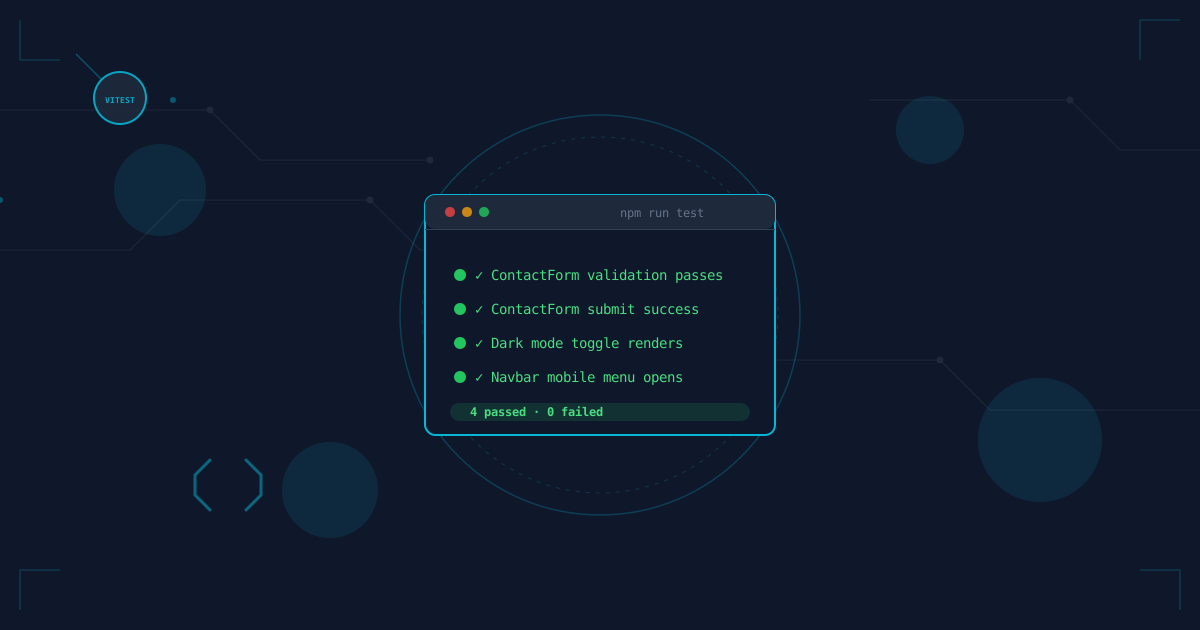
✅ should handle zero position size
🏃♂️ How to Run Tests
Add these scripts to your application's package.json before using the commands below:
{
  "scripts": {
    "test": "vitest",
    "test:run": "vitest run",
    "test:ui": "vitest --ui",
    "test:coverage": "vitest run --coverage"
  }
}
The optional UI and coverage commands also require @vitest/ui and @vitest/coverage-v8, respectively. Install versions matching your installed Vitest version. For TypeScript globals, include vitest/globals in the test project's compilerOptions.types. Adapt the aliases, mocks, and domain imports to your application; this article is not a standalone test fixture. Vitest does not currently support testing async Next.js Server Components directly; use end-to-end tests for those.
# Development - watch mode
npm run test
# → Watches for file changes, re-runs tests

# CI/CD - single run
npm run test:run
# → Runs all tests once, exits with status code

# Visual interface
npm run test:ui
# → Opens browser with test UI, coverage, etc.

# Coverage report
npm run test:coverage
# → Shows % of code covered by tests
🎯 Why This Testing Approach
Benefits for Trading App:
- Financial Accuracy - P&L calculations must be perfect
- Edge Case Protection - Zero values, null values, negative numbers
- Regression Safety - Future changes won't break existing logic
- Documentation - Tests show exactly how functions should behave
TDD Benefits:
- Think First - Define behavior before coding
- Confidence - Tests prove code works
- Refactor Safety - Can improve code without breaking functionality
🧪 Component Testing Example
Here's how we test a React component:
// test/components/TradeCard.test.tsx
import { describe, it, expect } from 'vitest'
import { render, screen } from '@testing-library/react'
import userEvent from '@testing-library/user-event'
import { TradeCard } from '@/components/TradeCard'

describe('TradeCard Component', () => {
  it('should display trade information correctly', () => {
    // Arrange
    const trade = {
      id: '1',
      symbol: 'AAPL',
      entry_price: 150,
      exit_price: 160,
      position_size: 100,
      trade_direction: 'Long' as const,
      created_at: '2025-01-15T10:00:00Z'
    }

    // Act
    render(<TradeCard trade={trade} />)

    // Assert
    expect(screen.getByText('AAPL')).toBeInTheDocument()
    expect(screen.getByText('$150.00')).toBeInTheDocument()
    expect(screen.getByText('$160.00')).toBeInTheDocument()
    expect(screen.getByText('Long')).toBeInTheDocument()
  })

  it('should handle delete button click', async () => {
    // Arrange
    const mockOnDelete = vi.fn()
    const trade = {
      id: '1',
      symbol: 'AAPL',
      entry_price: 150,
      exit_price: 160,
      position_size: 100,
      trade_direction: 'Long' as const,
      created_at: '2025-01-15T10:00:00Z'
    }
    const user = userEvent.setup()

    // Act
    render(<TradeCard trade={trade} onDelete={mockOnDelete} />)
    await user.click(screen.getByRole('button', { name: /delete/i }))

    // Assert
    expect(mockOnDelete).toHaveBeenCalledWith('1')
  })
})
📊 Integration Testing Example
Testing how components work together:
// test/integration/TradeJournal.test.tsx
import { describe, it, expect } from 'vitest'
import { render, screen } from '@testing-library/react'
import userEvent from '@testing-library/user-event'
import { TradeJournal } from '@/components/TradeJournal'

// Mock the API calls
vi.mock('@/lib/api', () => ({
  getTrades: vi.fn(() => Promise.resolve([])),
  createTrade: vi.fn(async (trade) => ({ ...trade, id: '1' })),
}))

describe('TradeJournal Integration', () => {
  it('should allow adding a new trade', async () => {
    // Arrange
    const user = userEvent.setup()
    render(<TradeJournal />)

    // Act - Fill out the form
    await user.type(screen.getByLabelText(/symbol/i), 'AAPL')
    await user.type(screen.getByLabelText(/entry price/i), '150')
    await user.type(screen.getByLabelText(/exit price/i), '160')
    await user.type(screen.getByLabelText(/position size/i), '100')
    await user.click(screen.getByRole('button', { name: /add trade/i }))

    // Assert - Trade should appear in the list
    expect(await screen.findByText('AAPL')).toBeInTheDocument()
    expect(screen.getByText('$150.00')).toBeInTheDocument()
  })
})
🎯 Best Practices We Follow
-
Test Behavior, Not Implementation
// Good - Test what user sees expect(screen.getByText('Total: $100')).toBeInTheDocument() // Bad - Test internal state expect(component.state.total).toBe(100) -
Use Meaningful Test Names
it('should calculate profit for long trades') // Clear it('test1') // Not helpful -
One Assertion Per Test (When Possible)
it('should display symbol', () => { expect(screen.getByText('AAPL')).toBeInTheDocument() }) it('should display entry price', () => { expect(screen.getByText('$150.00')).toBeInTheDocument() }) -
Mock External Dependencies
// Always mock APIs, databases, external services
vi.mock('@/lib/supabase', () => ({
  supabase: { /* mock implementation */ }
}))
This testing setup ensures our trading journal's financial calculations are bulletproof and our UI works as expected! 🎯